
Sundarbans Tree Composition Is Changing as Sundri Dominance Declines
97 Repoter: 97 Admin
Publish : 2 hours agoUpdate: 22 minutes ago
Sundarbans Tree Composition Is Changing as Sundri Dominance Declines
Sundarbans Tree Composition Is Changing as Sundri Dominance Declines
The Sundarbans, the world's largest mangrove forest, is undergoing gradual changes in its tree composition and natural regeneration patterns. Recent research suggests that the dominance of Sundri, one of the forest's most important tree species, has declined over time, while Gewa has expanded in some areas and Kankra has shown notable growth in parts of the forest.
A 2025 study by researchers from the Mangrove Silviculture Division of the Bangladesh Forest Research Institute examined the natural regeneration dynamics of the Sundarbans between 2010 and 2020. The study used data from 30 permanent sample plots and analysed 14 seedling species, 10 sapling species and 10 tree species.
Seedling Density Fell by More Than Half
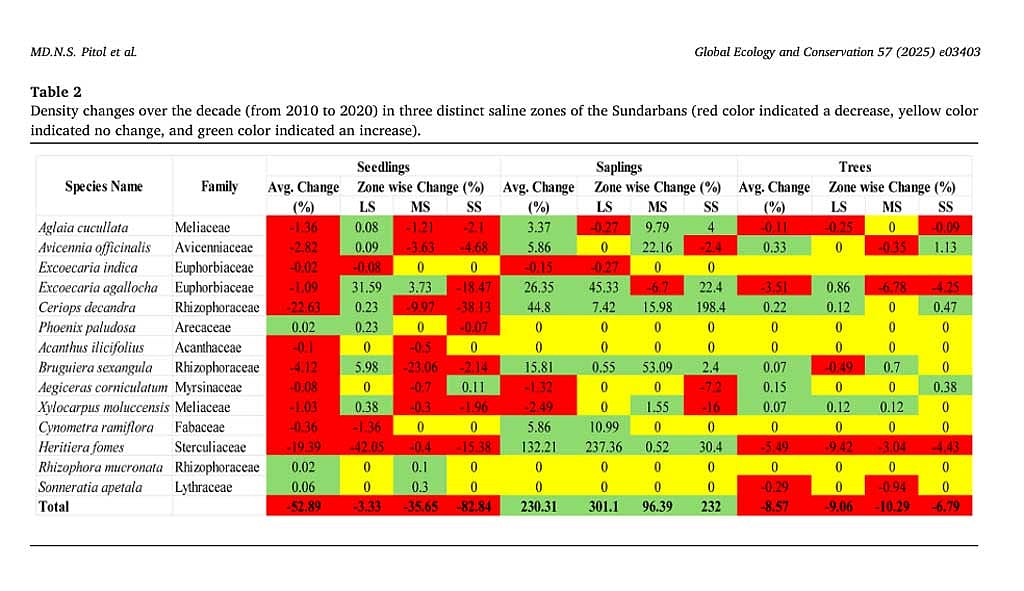
One of the key findings of the study was a 52.89% decline in overall seedling density between 2010 and 2020. However, the number of saplings increased by 230.31% during the same period.
This suggests that although a significant proportion of newly emerging seedlings did not survive, a considerable number of plants that reached the sapling stage continued to grow successfully.
The changes varied significantly across salinity zones.
Seedling density declined by only 3.33% in low-salinity areas, compared with 35.65% in moderately saline zones and 82.84% in highly saline areas.
At the sapling stage, however, density increased by 301.1% in low-salinity areas, 96.39% in moderately saline zones and 232% in highly saline areas.
The findings indicate that the future of the Sundarbans cannot be assessed simply by counting trees. The survival and expansion of individual species across different ecological zones are equally important.
Sundri Dominance Is Declining
The 2025 research found a decline in the dominance of Sundri, scientifically known as *Heritiera fomes*, over time. At the same time, Gewa, or *Excoecaria agallocha*, showed signs of habitat expansion.
However, the researchers also found that the overall biodiversity of the Sundarbans remained relatively stable during the study period. Species composition varied across different salinity zones, meaning the changes are not uniform throughout the entire forest.
This distinction is important. The research does not suggest that one species is simply disappearing everywhere and being replaced by another. Instead, the structure of the mangrove ecosystem is changing in response to environmental conditions.
Kankra Expansion Detected in Chandpai Range
Another major study published in *Scientific Reports* in August 2026 examined the long-term expansion of Kankra, scientifically known as *Bruguiera gymnorhiza*, in the Chandpai Range of the northern Sundarbans.
Researchers analysed Landsat satellite imagery from 1988, 1989, 2000, 2010 and 2022, along with higher-resolution reference imagery and field information.
The study found that around 1,785 hectares of Sundri-Gewa-dominated areas in the study region had shifted into high-density Kankra-dominated areas, while another 3,000 hectares had transitioned into moderate-density Kankra-dominated areas.
The research provides quantitative evidence that Kankra has expanded over several decades in the Chandpai Range.
However, this does **not mean that Kankra has replaced Sundri throughout the entire Sundarbans**. The study focused specifically on the Chandpai Range, meaning its findings should not be treated as a complete picture of the entire forest.
Why Is the Forest Changing?
Salinity is one of the major environmental factors influencing vegetation patterns in the Sundarbans.
The 2025 regeneration study examined salinity along with factors such as siltation, precipitation and soil conditions to understand how the forest changes over time and across ecological zones.
Researchers and environmental experts have long pointed to changes in freshwater availability and rising sea levels as important pressures on the Sundarbans. Changes in tidal flow, sedimentation, climate conditions and human interventions can also influence the balance between freshwater and saline environments.
As salinity increases, species with greater tolerance to saline conditions may gain an ecological advantage in certain areas. Species that depend more heavily on lower-salinity environments may face greater pressure.
A Changing Forest Does Not Automatically Mean a Dying Forest
The latest research should not be interpreted as proof that the entire Sundarbans is collapsing.
The 2025 study found that overall biodiversity remained relatively stable, even though species composition and regeneration patterns varied across salinity zones. This highlights the fact that the Sundarbans is a dynamic ecosystem in which different species respond differently to environmental changes.
At the same time, long-term changes in important species such as Sundri deserve close monitoring. The balance among tree species is closely connected to the forest's biodiversity, carbon storage and overall ecological health.
Why Long-Term Monitoring Matters
Understanding the future of the Sundarbans requires continuous monitoring through field surveys, permanent sample plots, satellite imagery and remote-sensing technology.
The 2026 Kankra study demonstrates how multi-decadal satellite data can be used to identify changes in the dominance of individual tree species. The researchers reported classification accuracies of 90.67% for 1988 and 92.67% for 2022.
Meanwhile, the 2010-2020 regeneration study shows why scientists need to monitor the complete lifecycle of forest regeneration—from seedlings to saplings and eventually mature trees.
The Future of the Sundarbans Depends on Ecological Balance
The Sundarbans exists at the intersection of freshwater and saline environments. Any long-term change in that balance can influence which tree species are able to survive and expand.
Therefore, the key question is not simply whether Sundri, Gewa or Kankra is increasing or decreasing. Researchers also need to understand **why these changes are happening, where they are occurring, how salinity is influencing them and what they could mean for the long-term health of the ecosystem.**
The latest studies present the Sundarbans as a **dynamic and naturally regenerating ecosystem that is nevertheless undergoing significant ecological changes**. The findings highlight both the need for concern and the importance of continuous research, monitoring and conservation efforts to protect the forest's long-term resilience.